During pregnancy, the health of mother and child is the top priority. On the one hand, many rules and behaviours must be followed, e.g. a special diet or abstaining from nicotine and alcohol, and on the other hand, the pregnant woman must attend a wide range of appointments for preventive care and check-ups.
But what if there is something wrong with the woman's body and the findings are confirmed by means of a MRI–Investigation needs to be clarified? Is the Magnetic resonance imaging (also: magnetic resonance imaging) harmful to the embryo?


A note in advance
Many doctors and scientists speak of the general safety of an MRI during pregnancy if the examination is necessary. Despite the positive attitude of some colleagues and MRI experts, we recognise a possible risk for the baby. We therefore distance ourselves from MRI examinations in pregnant women in our practice and carry out No MRIs for pregnant women through. Other practices handle this differently. We are of the opinion that magnetic resonance imaging in pregnant women should only be carried out in specialised facilities or hospitals if there is a vital indication, i.e. in the case of life-threatening conditions that require life-saving measures.
An MRI is a reliable, safe examination method
There are many preconceptions about MRI: The examination is carried out using radioactive radiation, there are high temperatures, the noises are loud, the knocking is harmful. All this can worry patients. But don't worry: these are just rumours!
The fact is that the MRI diagnostics is currently one of the best imaging techniques. It can produce precise images of organs, soft tissue, bones and blood vessels. Magnetic resonance imaging is generally used, for example, to recognise bone fractures, bleeding, inflammation, vascular changes and stenoses. It can also be used to reliably diagnose overstretching and tears in ligaments and tendons. The examination is also suitable for assessing the extent of osteoarthritis. An MRI is also a valuable aid in tumour diagnostics.
And most importantly, there are no known harmful effects of this examination method.
MRI in pregnant women: Divided opinions
Pregnant women who may need an MRI scan are naturally afraid for their baby, worried about physical malformations of the child or even a pregnancy loss as a result of the examination.
Many doctors are of the opinion that MRI is not dangerous for either the mother or the child. They base their theory on the fact that the examination - unlike a conventional X-ray or CT scan - does not produce any ionising radiation are used. This also means that the patient and her baby are not exposed to any radiation or radioactivity.
A second aspect concerns tissue heating, which can occur during an MRI and may even be noticeable to the patient.
Many mothers-to-be are therefore concerned that the increased temperature could be harmful to the baby. Some doctors believe that this is not the case, as the potential increase in temperature is very small.
The third potentially critical point concerns the knocking noises of the MRI, which are perceived as very loud by some patients. Here too, there is often a fear that the increased volume level could be harmful to the embryo. Advocates of magnetic resonance imaging in pregnant women argue that there is no scientific data to prove this.
However, there is also agreement on some points: this concerns both the time of the examination during pregnancy and the administration of contrast media.
The following applies: As a precaution, the examination method should not be carried out in the first trimester of pregnancy (exception: a vital indication for the mother).
Experts also advise that contrast agents should not be administered during pregnancy. The drug gadolinium, for example, is suspected of favouring rheumatic or other inflammatory diseases in children in the first four years of life if the mother had to take it during pregnancy for an examination.
Conclusion: Jain on MRI in pregnant women
Pregnancy does not rule out magnetic resonance imaging in principle. However, the indication should always be considered („Does an MRI help us with the diagnosis?“). If the necessity and benefit of an MRI are questionable, it should be avoided during pregnancy.
MRI Frankfurt
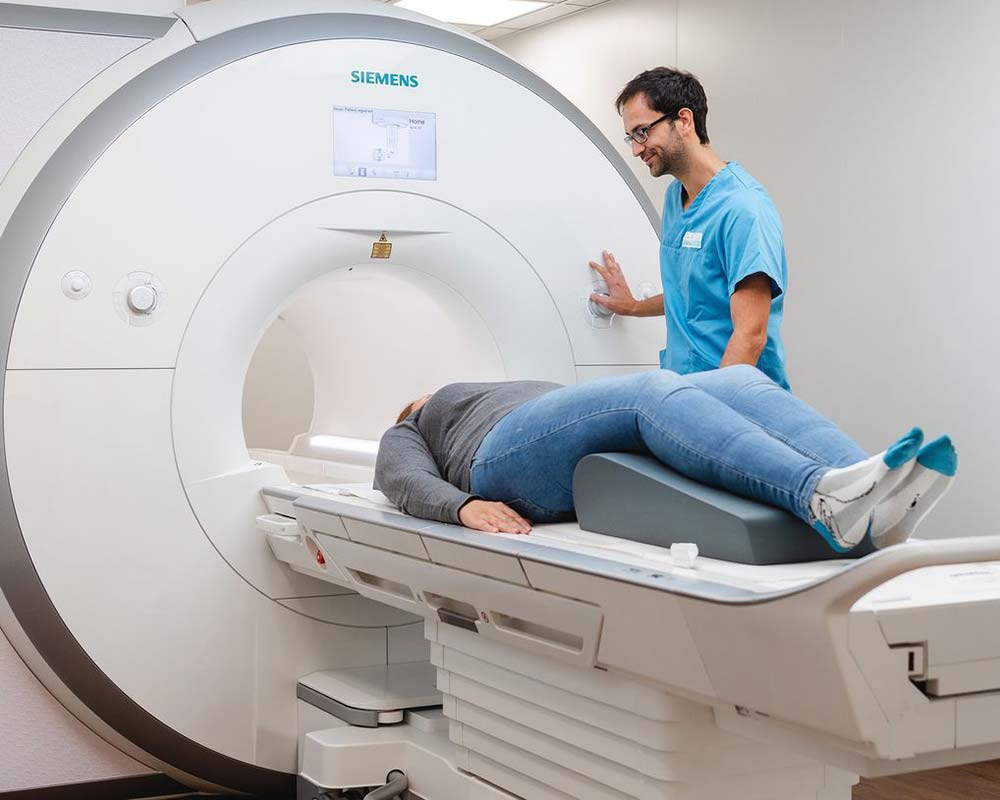
We specialise in magnetic resonance imaging and offer the following services in our Practice in Frankfurt state-of-the-art technology. Our MRI machine has a Tube diameter of 70 cm and is therefore much wider than conventional devices. With MoodLight illumination and customised music, we ensure a pleasant atmosphere during the examination. As a precaution, however, we do not examine pregnant women, as we cannot completely rule out a risk to the baby.