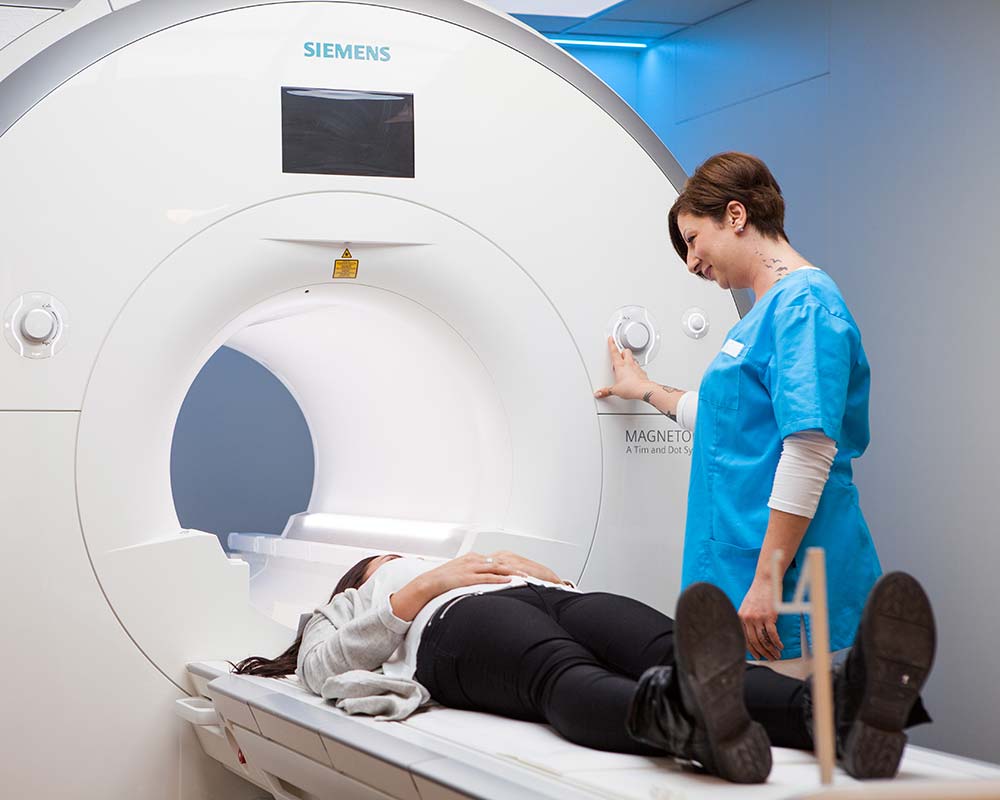
While many years ago, tattoos tended to be relegated to the „dirty corner“, attitudes towards them have changed considerably: Tattoos are more trendy than ever. They are considered an art form and have almost become a must-have for many people. But as beautiful and attractive as the body jewellery is, the colours used can contain iron (or small traces of it).
Since an MRI is a diagnostic procedure based on a strong magnetic field, many patients ask themselves: „Can I have an MRI with a tattoo? Is there any risk of damage to my body or the tattoo? And how will my tattoo affect the results of the examination?“ We answer these questions on this page.


MRI can be done with tattoo
In principle, magnetic resonance imaging can be carried out on people who have tattoos without any problems. However, to be on the safe side, some aspects should be discussed with the registration centre before the examination. Radiological private practice from Dr Catarina Jung be discussed.
Tattoo colours used
It is important that you inform us about the ingredients of your tattoo colours. Older tattoos (before 1990) may have been inked with colours that contain magnetically active ingredients (e.g. iron carbonates, iron hydroxide, iron oxide). Since the 1990s, colours have been used in Germany that generally contain few to no magnetic ingredients and are therefore suitable for MRI. However, the use of magnetic substances is not prohibited. This means that magnetic substances can still be found in certain colours - albeit in very small quantities: These include iron hydroxide and iron carbonate in white, iron oxide in red and iron ammonium ferrocyanide in blue. The colours red, white and black can therefore cause problems in rare cases during MRI examinations.
Localisation and size of the tattoo
Furthermore, the location and size of your tattoo may limit the success of the MRI scan. Tattoos that are located in the area of the body part to be examined can in certain cases lead to interference with the imaging. The situation is similar with particularly large tattoos that are located in the area of the body to be examined. Accordingly, tattoos that are located on a completely different part of the body are completely unproblematic. This means, for example, that a decorative image on the upper arm does not restrict the MRI in any way if it is carried out on the knee.
MRI does not damage the tattoo (exception: freshly engraved tattoos)
If you have to undergo an MRI scan, you do not need to worry that this will affect the look and texture of your tattoo: an MRI scan is not harmful to your tattoo. There are no consequences or negative effects to fear.
However, care should be taken with newly engraved tattoos. During the first six weeks after the „cut-off date“, an MRI examination should be avoided if possible. During tattooing, superficial skin cells and cell-to-cell contact are temporarily damaged or impaired. Therefore, freshly tattooed colours may run due to the magnetic field.
Risk of skin burns in people with tattoos in MRI?
Theoretically, the alignment of magnetic substances in the tattoos during the MRI examination can cause superficial first-degree burns to the skin. However, this is extremely rare.
To prevent this from happening, we give the patient a push button in their hand during the examination. They can press this at any time if they feel a warming sensation. This cancels the examination. A burn does not usually develop immediately, but the patient can feel it. This allows the patient to react in good time if the worst comes to the worst.
Study on tattoos in MRI: Only 2 out of 330 test subjects with tattoos had side effects
In a study conducted by Nikolaus Weiskopf (now Director at the Max Planck Institute for Human Cognitive and Brain Sciences in Leipzig) and his London colleague Martina Callaghan, the focus was on the question of whether tattoos are dangerous in MRI. The study was conducted over several years and the results were published in the New England Journal of Medicine at the beginning of 2019.
A total of 330 people with 932 tattoos took part in the study. Patients whose individual tattoos were longer than 20 cm and whose tattoos covered more than five per cent of their body surface were excluded from the study. Furthermore, subjects who had tattoos on their head, neck and/or genitals were not allowed to take part in the study. This naturally limits the significance of the study, but the scientists wanted to be on the safe side.
Before patients are admitted to the MRI tube the research team recorded the exact size of the individual tattoos, where they were located, which colours were used and which country the body artwork came from. The patients were then examined using powerful three Tesla MRI machines. This is a level of power that is used in many clinics (for comparison: the device in our MRI practice in Frankfurt works with a 1.5 Tesla high-field system).
The result: only two of the 330 test subjects with tattoos showed side effects. One reported a slight tingling sensation, the other noticed warming and a feeling of tension, whereupon the examination was cancelled. The patient recovered within a day without any signs of burning.
The research team explains this effect by the high-frequency field used in MRI to generate the images. This usually has a frequency of a few hundred megahertz. This allows resonance lengths of conductive structures to be achieved that roughly correspond to the length of a tattoo. Here, the tattoo can absorb a lot of the energy from this high-frequency field, which would normally be distributed over a wider area.
Nevertheless, the majority of the tattooed test subjects did not experience any side effects in the MRI. The undesirable side effects that affected two people are to be regarded as isolated cases.
MRI Frankfurt
Conclusion: In most cases, an MRI can also be carried out on people with tattoos without any side effects or restrictions. However, please talk to us about your tattoo before the examination.
We are recognised as a specialist practice for Radiology in Frankfurt and offer state-of-the-art technology. The MRI machine that we use for the examination has a tube diameter of 70 cm. This is much wider than conventional devices. MoodLight illumination and customised music ensure a pleasant atmosphere during the examination.