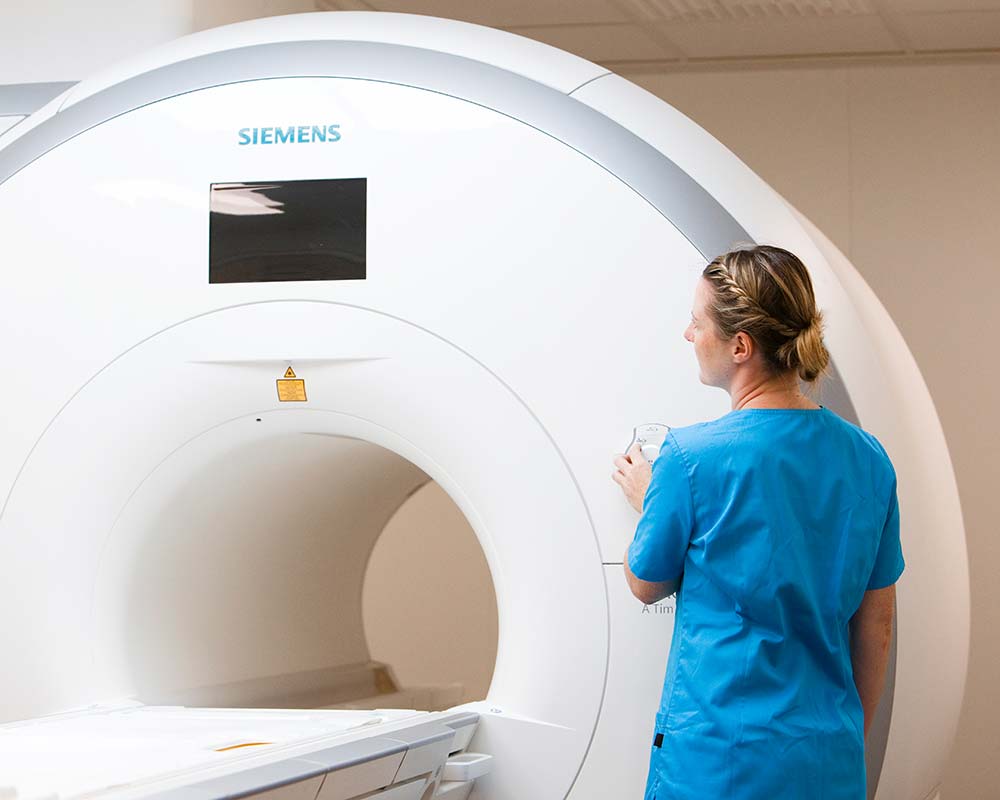
Magnetic resonance imaging (MRI for short) is one of the most important and informative imaging procedures today. Thanks to the outstanding speed of technological development, the examination has firmly established itself as an indispensable part of diagnostics.
One MRI can help with medical questions - and confirm assumptions or rule out diagnoses. For example, it helps to detect inflammatory diseases, changes in tissue, organs, bones, ligaments and tendons, as well as tumours and metastases. In addition to its wide range of applications, the examination method also has another major advantage: unlike other procedures, it does not with the MRT No potentially harmful radiation used.


The risks of ionising radiation
Radiation transports energy from the radiation source. This is transported, for example, as ionising energy in the case of X-rays. The energy transport here is greater than with visible light or infrared radiation.
Ionising radiation harbours a risk: matter that is penetrated by this type of radiation can be altered by it, as chemical bonds are broken or atoms and molecules are ionised. This means that one or more electrons are removed from an atom or molecule, leaving the atom or molecule as a positively charged ion (cation).
If ionising radiation hits living cells or organisms, it is possible that the corresponding chemical and physical processes will cause damage. Examinations based on ionising radiation (X-rays, fluoroscopy and computer tomography) can cause damage to genetic material when penetrating tissue. This damage to DNA is suspected of being harmful to health in the long term. Under certain circumstances, it can lead to cancer. As it must be assumed that any exposure to radiation can harbour a certain risk, too frequent X-ray examinations and CT scans (especially frequent repeat examinations that are not absolutely necessary) should be avoided.
Avoidance of ionising radiation during MRI
As already mentioned at the beginning, magnetic resonance imaging does not use ionising radiation. Instead, it relies on three different fields to create images:
Static magnetic field
MRI uses a strong, static magnetic field to generate the so-called nuclear magnetisation. Many studies have been carried out on this, none of which have identified any adverse health effects. The only possible risk lies in the magnetic attraction of metallic and ferromagnetic objects. They are strongly accelerated in the field of action of the magnet and can therefore develop into dangerous projectiles. For this reason, there are no such objects in the MRI room. By carefully and comprehensively informing our patients and, if necessary, their accompanying persons, we can exclude any danger from the body.
If a patient has had an operation involving the use of an implant (e.g. an orthopaedic prosthesis), they will receive an implant pass from their attending physician, which provides information on whether an MRI can be performed. In the case of hip and knee prostheses, for example, the examination can usually be carried out without hesitation. At most, the prostheses can lead to image restrictions.
Unfortunately, people with pacemakers, insulin pumps, neurostimulators or cochlear implants cannot be examined with magnetic resonance imaging (or only with the special authorisation of the examining doctor). Metal splinters in the facial area can also be critical. Furthermore, an MRI cannot be carried out if surgery has been performed on the brain vessels or if the auditory ossicles in the tympanic cavity were surgically replaced a long time ago.
Please let us know at the Make an appointment whether you have any restrictions.
Electromagnetic high-frequency fields
MRI also utilises so-called pulsed electromagnetic high-frequency fields, which excite the spin system. This can cause the patient's body tissue to heat up by a maximum of 1 degree Celsius. However, there is a rapid, natural temperature equalisation. This means that there is no risk to health. In addition, complex monitoring systems ensure that the temperature and the degree of warming during the examination remain harmless.
Gradient fields
The third field required for successful magnetic resonance imaging is a so-called pulsed, weak magnetic field. It is known as a gradient field. If it is switched on very quickly, nerve or muscle cells in the patient's body can be stimulated. This can result in contractions in the chest, shoulders, hips, buttocks or nose. Palpitations are also possible. But don't worry - an MRI control system ensures that the gradient fields are not set too quickly and therefore do not harm the patient.
MRI Frankfurt: No harmful examination
As you can see, one of the great advantages of MRI examinations is that they are harmless to health, as no ionising radiation is used and the body is therefore not exposed to any stress. This means that even more frequent examinations are harmless.
Arrange your appointment now Date in the radiological practice of Dr Catarina Jung!