When a child is due to have an MRI scan, it is often an unfamiliar experience for both parents and child. Images of the inside of the body help to make the right diagnosis and thus ensure the best possible treatment for any illness or injury.
Examinations using imaging techniques such as the MRI are associated with technology and large devices. They evoke a wide range of reactions in children, from curiosity to uncertainty and fear.
Radiological private practice Dr Catarina Jung
If you are looking for a radiological practice who is particularly well versed in MRI examinations in children, then Dr Catarina Jung is the right person for you. Radiological private practice in Frankfurt just right, because:
- We motivate your child for the examination by telling them that you can look inside their body from the outside - without it hurting - to find out why they are not feeling well and in this way the doctor can help them better.
- This is a harmless examination that can be cancelled if necessary.
- MRI examinations are also carried out in our practice on small children from approx. 4 years of age without sedation.
- Our team specialises in children. Both Dr Catarina Jung as well as the entire team are very child-friendly, empathetic and introduce children to examinations in a playful way.
- The use of MRI is painless and is particularly suitable for children due to the lack of radiation exposure.
Radiation protection for children and adolescents
Radiation protection is particularly important for children and adolescents as they are still growing up: their body cells divide more frequently and react more sensitively to X-rays than adult body cells.
Organisational procedure
- Examination dates can be arranged at short notice by telephone. Alternatively, you can book your preferred appointment online 24 hours a day and choose the best time for you to come to us with your child.
- Waiting times are avoided in the practice through optimal organisation.
- There is a children's book in the waiting room that explains everything worth knowing about MRI examinations with pictures and simple text for children.
- Parents are involved in the course of the examination and can stay with their child in the examination room throughout the MRI examination.
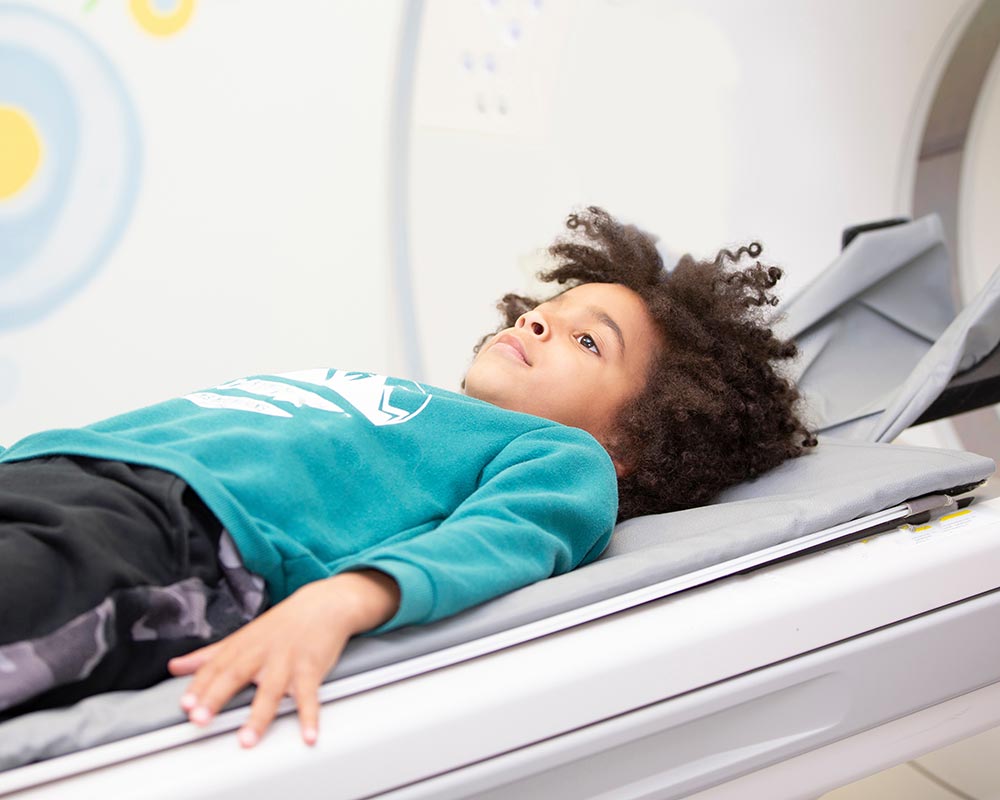
- The child may have a cuddly toy with them during the examination and listen to children's music or stories through headphones.
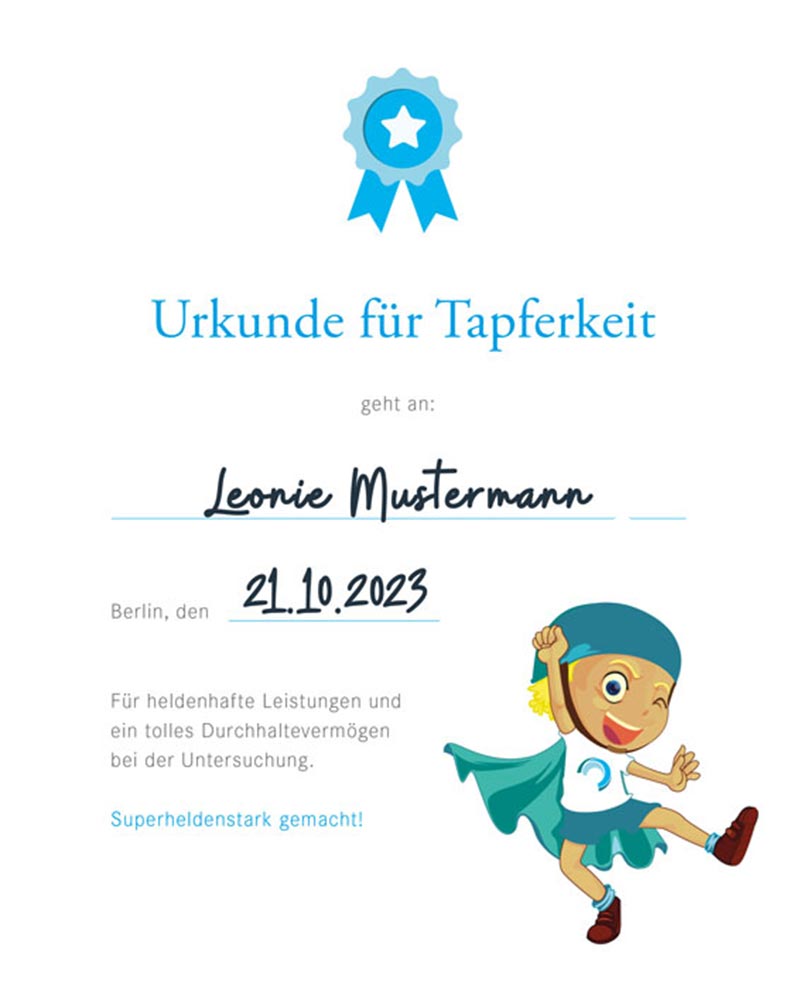
- After the MRI examination, the child is rewarded with a certificate of bravery.
How does the MRI examination work?
First of all, all metal objects such as watches, jewellery, hair clips or mobile phones must be removed. A cuddly toy or doll may be taken along, provided that it does not contain anything metallic. Comfortable clothing without metal parts, such as zips, may be left on.
The examination takes about 20 minutes and during this time you lie on a couch, which is moved into an open tube to varying degrees depending on the region being examined. Loud knocking noises are produced during the examination. So that these are not too disturbing, the young patients are given earplugs or headphones to listen to music, songs or favourite stories.
Immediately after the examination, the images from the MRI scan are shown on a large monitor in the doctor's room by Dr Catarina Jung and the results are explained in detail. Any open questions are answered together with the child and parents. A personally issued certificate of bravery rewards the child at the end of the examination. The images of the examination are handed out in the form of a CD and an additional QR code, which can be used to view the images online on the internet.
How does an MRI work?
To understand how MRI works, let's take a short trip into the world of atoms. All substances in the environment, including the human body, are made up of atoms. These are tiny particles, invisible to the eye even under a microscope, which consist of an outer shell and a nucleus.
The body's tissues and organs consist primarily of water, which in turn is made up of hydrogen atoms. The nuclei of the hydrogen atoms play a decisive role in MRI, as they behave like mini magnets in the body.
As soon as the patient lies in the MRI tube, these mini-magnets arrange themselves in the tissues in the MRI magnetic field. Now the radio waves come into play. They are directed at the examination region from the outside and deflect the atomic nuclei out of the position they have just assumed. When the radio waves are switched off, the atomic nuclei immediately jump back to their original position in the magnetic field. In doing so, they emit signals that can be measured using highly sensitive antennas.
A computer calculates numbers from these signals, which in turn are converted into different shades of grey on the image. Diseased or injured tissue appears in a different shade of grey than healthy tissue. When examining the knee, a total of 100 to 200 wafer-thin cross-sectional images are created in different planes without the patient having to change their position.
The MRI scan is a very valuable diagnostic method that is particularly suitable for children and adolescents. It makes it possible to detect many injuries or illnesses at an early stage. This lays the foundation for successful treatment.
MRI scan for children: make an appointment now
If you have any questions or uncertainties before your MRI scan, you are welcome to send us a message or ask us in person. Arrange your appointment now Date in the radiological practice Dr Catarina Jung!