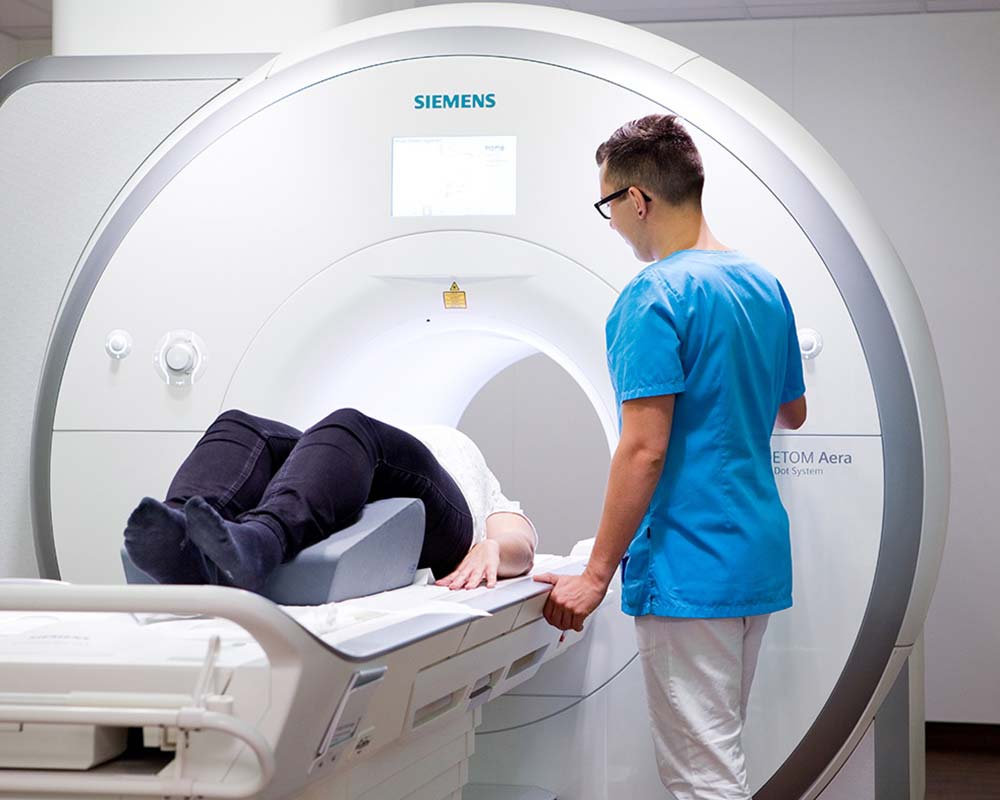
Patients in and around Frankfurt who require an MRI examination are in good hands at Dr Catarina Jung's private radiology practice. Magnetic resonance imaging (MRI for short) is an innovative and very safe diagnostic procedure in radiology. It can be used to produce razor-sharp tomograms of almost any region of the body.


MRI Frankfurt: What is magnetic resonance imaging?
The abbreviation MRI stands for magnetic resonance imaging and is also referred to as nuclear spin tomography or colloquially as nuclear spin. An MRI is a diagnostic imaging procedure.
With the help of a computer, a strong magnetic field, additional alternating fields and measuring antennas, sectional images of the inside of the body are generated. These images are usually very detailed and can even show small changes taking place in the body. The MRI enables images of any desired body plane in different views: across the body, lengthwise and oblique.
MRI Frankfurt: When is magnetic resonance imaging used?
MRI is used by doctors as an imaging diagnostic procedure to diagnose or rule out a wide variety of illnesses or injuries (e.g. severity of osteoarthritis, bone fractures, haemorrhages, inflammation, vascular changes and stenoses, overstretching and tears in ligaments and tendons).
MRI is also used for tumour diagnostics. This means that the suspicion of cancer can be confirmed or, in the best case, ruled out. MRI can also be used to find any metastases, i.e. metastases of a tumour. MRI can also be used to monitor and assess the course of medical therapy.
MRI Frankfurt: Which parts of the body can be imaged?
Magnetic resonance imaging (MRI) can be used for the diagnosis of diseases and functional disorders in all areas of the body. The main areas of application for our MRI in Frankfurt are:
- MRI of the head area
Neurocranium (head), head and cervical spine, temporomandibular joints, paranasal sinuses, soft tissues of the neck - MRI of the upper body and axial skeleton
Cervical spine, shoulder, collarbone, thoracic spine, rib cage, lumbar spine, sternum, coccyx, upper arm, elbow, forearm, wrist, metacarpus and fingers - MRI of the abdomen
Upper abdomen, lower abdomen, upper and lower abdomen, (with change of position) - MRI of the legs and feet
Hip joint, thigh, knee, lower leg, ankle joint, Achilles tendon, foot - MRI special examinations
Angiography of the head vessels, visualisation of the neck vessels, angiography of the aorta and renal vessels
Further information can be found in our overview of the Study regions.
Advantages of our MRI examination in Frankfurt
- Gentle and painless examination procedure without radiation exposure, therefore frequent examinations are also harmless
- Safe use for Children due to lack of radiation exposure
- Detailed examination of organs, joints, blood vessels, bones and tissue, in any plane and cutting direction
- Excellent visualisation of the vessels without the use of invasive methods
- High contrast between healthy tissue and pathological changes
- Diagnoses can be made after a short time
- Switching to MRI is possible if a patient cannot tolerate iodine-containing contrast media (as may be necessary for CT)
- Fast appointments for MRI examinations in Frankfurt with no waiting time at the practice
- Short examination times thanks to optimised technology
MRI in the radiological practice of Dr Catarina Jung in Frankfurt
The Private practice for radiology Dr. med. Catarina Jung is located in Haus Castanea, very close to the Alte Oper. The practice rooms within the Beyond Imaging diagnostic centre are accessible and can be reached by lift.
The practice of Dr Jung is not called a specialised MRI practice in Frankfurt for nothing: With state-of-the-art technology, MRI examinations are possible even for obese patients or patients with Claustrophobia This is possible without any problems as the device is wider than conventional devices with a tube diameter of 70 cm. In addition, the very short magnet means that many examinations can be carried out with the patient's head outside the tube. MoodLight illumination and customised music ensure a feel-good atmosphere during the examination.
The modern MRI not only offers comfort for all patients, but also impresses with its technical performance: it delivers excellent image quality and therefore very high diagnostic reliability. The MRI images are provided after the examination in the form of a CD-ROM and can be transmitted digitally to the specialist providing further treatment via the secure web archive.